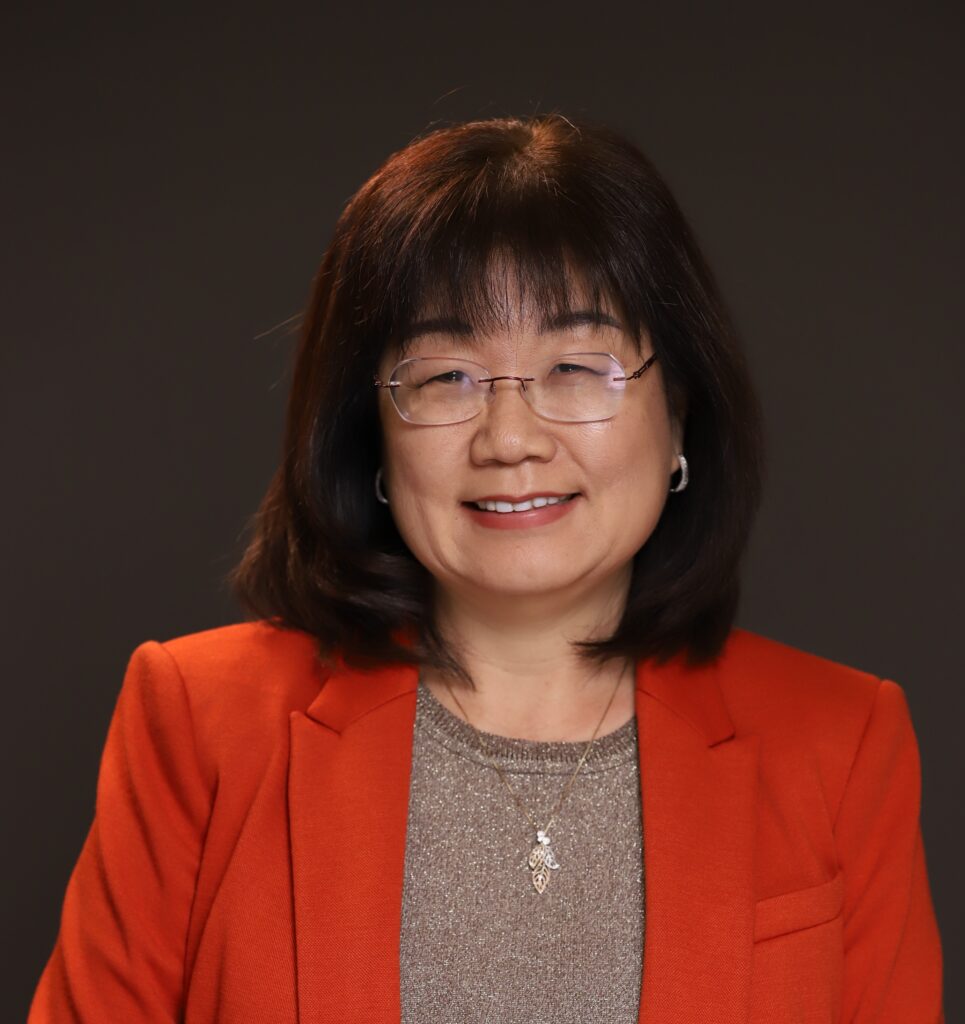
Written by: Grace Cho, Professor at California State University, Fullerton; Californians Together Board Member
People often ask me why I have dedicated my life to multilingual education. The answer begins with my own journey.
I have learned three languages in three countries. Each language taught me something different—not only about language learning, but also about the power of educational opportunity.
I am a Korean immigrant, educator, and researcher whose multilingual journey has taken me from Korea to Argentina and eventually to the United States. Those experiences shaped not only my life, but also my understanding of how educational systems can either create opportunities or become barriers for multilingual learners. They ultimately inspired my lifelong commitment to multilingual education.
My journey as a multilingual learner spans two very different educational experiences.
When my family immigrated from Korea to Argentina, none of us spoke Spanish. It was a completely new language for our entire family. Up to that point, we had spent years learning mathematics, science, history, and other subjects in Korea. Those understandings did not disappear when we immigrated. What changed was our ability to learn and demonstrate what we already knew in a language we did not yet understand.
There was no instructional support for students learning Spanish as a new language. We were placed directly into local schools and expected to learn Spanish while keeping pace academically—a true sink-or-swim experience. Looking back now as an educator, I realize how easily multilingual learners’ abilities can be underestimated when language proficiency is confused with academic potential.
Fortunately, my parents never confused language with ability. Although there was no instructional support at school, they became our greatest teachers at home. They believed in education, encouraged us to continue learning, and preserved our Korean language and identity. Looking back, I now realize that they were providing the support that helped us persevere long before I had the language to describe what they were doing.
Several years later, my family immigrated again, this time to the United States.
Learning English was every bit as difficult emotionally. I was a teenager who had left behind friends, familiar surroundings, and everything I knew. I cried almost every day during those first months. Although my family had very little financially, my mother somehow found a way to buy me a piano because she knew I needed an outlet for the loneliness and stress I carried. Even today, whenever life becomes overwhelming, I still sit down at the piano—not because I am an accomplished pianist, but because it continues to bring me peace.
I knew I was a stranger in a new country, but I also knew who I was. My Korean language, culture, and family gave me a strong sense of identity. Looking back, I now realize that my heritage language did not prevent me from learning new languages. Instead, it gave me the confidence to face uncertainty and begin again.
Academically, however, my experience in the United States was fundamentally different from what I had experienced in Argentina. I entered an English Language Development (ELD) program that recognized I was learning a new language and provided a structured pathway for me to develop English while continuing my education alongside students my own age.
Was the ELD program perfect? Certainly not. Having later served as an elementary teacher, World Language coordinator, and teacher educator, I have seen firsthand many areas where these programs can and should improve. Yet the difference was profound. Instead of simply expecting me to “figure it out,” the program acknowledged that multilingual learners need intentional instructional support. It gave me something I had never experienced before—a pathway.
That pathway changed the trajectory of my life. It allowed me to graduate from high school, attend the University of Southern California, earn my bachelor’s degree, teaching credential, master’s degree, and eventually my Ph.D. Without that pathway, I often wonder whether my educational journey would have ended long before I ever stepped onto a university campus.
As I began my career in education, I witnessed another challenge facing immigrant families.
When my family first arrived in the United States, many well-meaning friends and church members encouraged my parents to stop speaking Korean at home so their children would learn English more quickly. Fortunately, my parents chose not to follow that advice.
Nearly twenty years later, many of those same parents came to me in tears because they could no longer communicate meaningfully with their children. Around the same time, their now-grown children shared their own sadness that they could not express themselves beyond simple conversations with their parents. Watching both generations experience the pain of heritage language loss profoundly affected me. Those conversations became the foundation of my first research study and ultimately shaped my career as a researcher, teacher educator, and advocate for multilingual education.
Years later, I had the opportunity to return to Korea as part of a project with the Gyeonggi Provincial Office of Education to study multilingual education programs serving a rapidly growing multilingual student population.
As I visited schools and spoke with teachers and administrators, I was struck by how familiar the conversations sounded. Educators genuinely wanted their multilingual learners to succeed, but many lacked the preparation, instructional models, and resources needed to support them effectively. I realized that although the countries were different, the questions were remarkably similar.
Across different countries, languages, and educational systems, I have learned one enduring lesson: multilingual learners do not need lower expectations. They need meaningful support, strong educational pathways, and opportunities to demonstrate what they already know and can become.
That is why I believe so deeply in the vision of Multilingual Education for All (MLE4ALL).
Multilingual education is not about choosing between English and a home language. It is about creating opportunities for students to develop English while preserving the languages, cultures, and relationships that shape who they are. When we invest in multilingual learners, we are investing in families, communities, and the future of our society.
My journey began as a Korean immigrant learning Spanish in Argentina and English in the United States. Today, it continues as I work alongside educators, families, communities, and policymakers to help ensure that every multilingual learner has the opportunity not simply to survive in school—but to thrive.