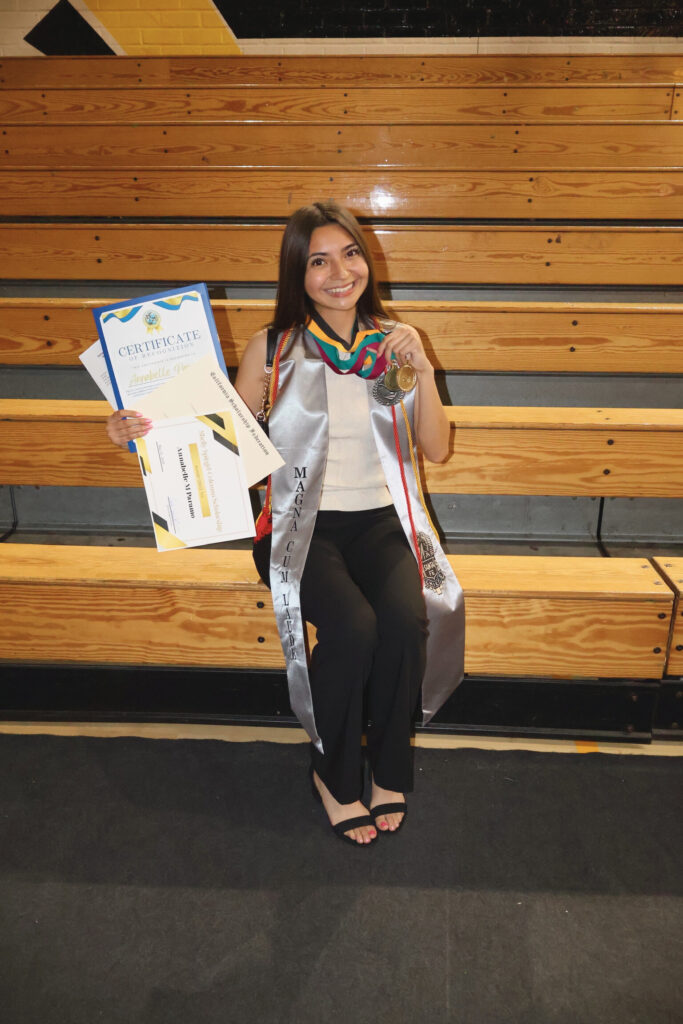
With more California students than ever earning the Seal of Biliteracy, each recipient has a unique story about how they achieved this milestone. These journeys shed light on the policies, practices, and personal determination that make multilingual success possible. One such story comes from Annabelle, a Santa Fe High School graduate, who sat down with Californians Together to share her path.
Building Two Languages from the Start
Growing up, Annabelle spoke Spanish with her grandmother and English with her parents, which helped her learn both languages at once. Her parents recognized the importance of bilingualism and opted to enroll her in a dual language program for preschool and kindergarten.
Her classrooms were alive with bilingual learning: illustrations of the English and Spanish alphabets lining the walls, chants and songs in both languages, and teachers switching seamlessly between the two. “It’s like a bridge to my culture and my family,” Annabelle recalls.
While Anabelle’s middle school did not have the same program, she held onto her Spanish, communicating with her grandmother, listening to Spanish language music, and enjoying telenovelas. By maintaining her home language, she earned a pathway award at her elementary school, laying the foundation for future success.
Discovering the Seal
Annabelle’s parents, both teachers, read through every information packet they received when she started high school. Her mom noticed a document filled with information about the State Seal of Biliteracy requirements. “Personally, I did want to receive the Seal. So I took Spanish classes until I could get it”. A representative from Spanish Horizons outlined for Annabelle the different pathways for attaining the Seal. . For Annabelle, that pathway included tackling the AP Spanish exam.
Rising to the Challenge
Though many of her classmates spoke Spanish more frequently at home, Annabelle quickly learned that the AP test was about more than conversational fluency. “The test requires you to write full essays. Reading, writing, and listening are big components,” she explains. She acknowledges that this can feel intimidating–even for students fluent in their home language.
For Annabelle, the hard work paid off. “Getting a 5 was just a great moment to me,” she says with pride. That score secured her Seal of Biliteracy and even earned her two college credits.
Looking Ahead
Now a first-year student at the University of California, San Diego, Annabelle wants to inspire others to embrace multiliteracy. “Don’t give up on that idea. [Losing interest in language learning] would be so limiting for children to grow. I think learning a different language helps so much. Even if it’s intimidating. It encouraged me to do different things.”
Her journey is a reminder that the Seal of Biliteracy is more than an award—it’s an investment in identity, culture, and opportunity.