Close to three-fifths (59%) of California’s youngest learners are multilingual, meaning there are close to one million 0-5 multilingual learners in California. Californians Together partnered with the English Learner Workforce Investment Initiative (EL-WIN) to elevate the critical need for the child care workforce to honor the language, culture, and race of these students. The charts below show there is a large disparity between the proportion of multilingual learners and their multilingual educators. Yellow represents Multilingual teachers and providers while blue represents Monolingual teachers.
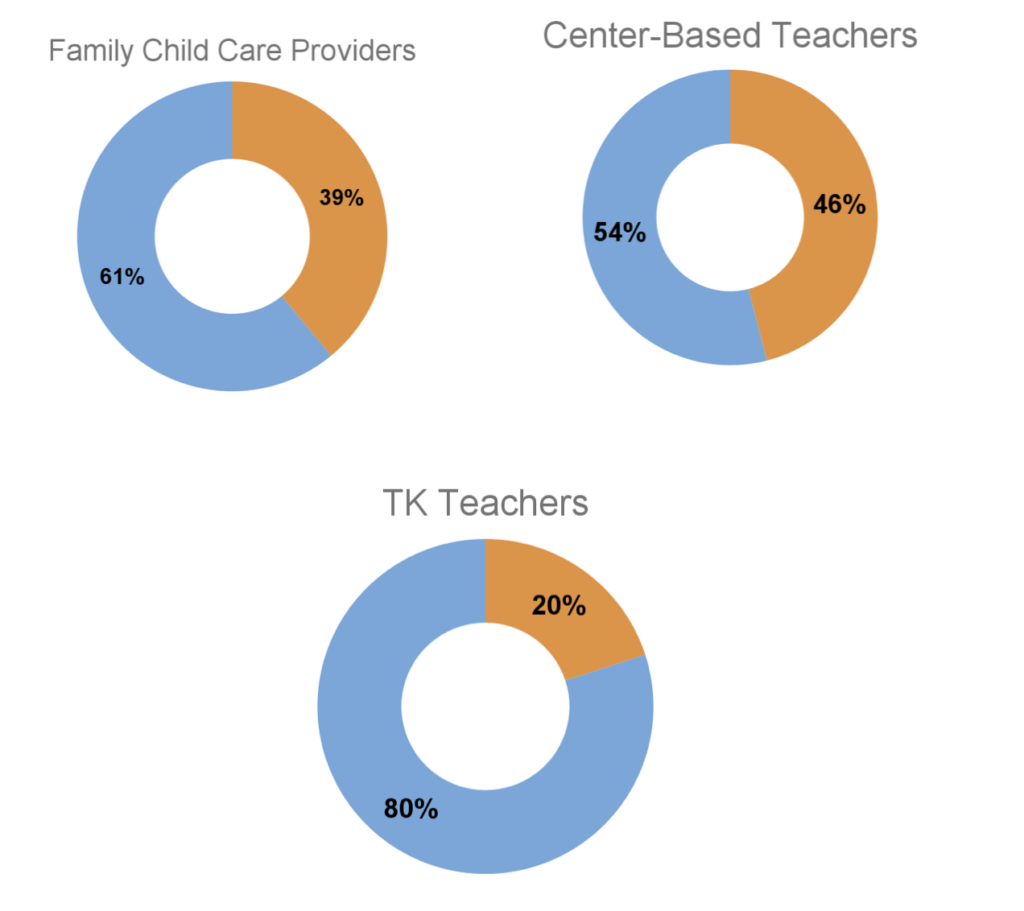
Yellow = Multilingual teachers & providers
Blue = Monolingual teachers
How Does California Meet This Need?
- Statewide Partnerships
- California has a robust network of early childhood education and dual language learner centered organizations who, together, continue to create lasting change.
- Recruitment and retention of multilingual-ready early childhood educators
- By focusing on bilingual proficiency, dual language development, and culturally responsive pedagogy, California can ensure that its educators are equipped to provide high-quality instruction to the state’s youngest multilingual learners.
- Addressing the issue of low compensation is vital to stabilizing the early childhood workforce. Equitable pay structures, opportunities for professional growth, and targeted financial incentives are critical to retaining qualified educators, particularly in high-need areas.
- By focusing on bilingual proficiency, dual language development, and culturally responsive pedagogy, California can ensure that its educators are equipped to provide high-quality instruction to the state’s youngest multilingual learners.
- Workforce Development
- By centering the English Learner Roadmap policy in early care and education and leveraging resources from California Early Childhood Online and the Faculty Initiative Project, the state can ensure that multilingual learners—especially in rural and underserved communities—receive the language and learning supports they need and fully capitalize on existing resources to support educators at every level.
- Mixed delivery early childhood education
- TK-12
- County Offices of Education
- Child Care Resource and Referral Agencies
- Institutes of Higher Education
- Other professional development providers
- Through aligned professional development opportunities, and creating accessible career pathways, California can support prospective educators from diverse backgrounds in becoming multilingual-ready educators.
- California can enhance the credentialing pathway through collaboration between Local Educational Agencies, Institutes of Higher Education, and county offices of education.
- By centering the English Learner Roadmap policy in early care and education and leveraging resources from California Early Childhood Online and the Faculty Initiative Project, the state can ensure that multilingual learners—especially in rural and underserved communities—receive the language and learning supports they need and fully capitalize on existing resources to support educators at every level.
- Creating coherent Early Education pathways for career advancement
- Creating coherent early education pathways for career advancement requires intentional coordination across California’s early learning and educator preparation systems. Through partnership with the California Department of Education, the California Commission on Teacher Credentialing, California Community College Early Childhood Educators, the California Child Development Consortium/Curriculum Alignment Project, California’s State Educator Workforce Collaborative, PEACH, and the array of mixed delivery system interest holders, the state can better align efforts to support the early childhood workforce.
- A statewide scan of multilingual early childhood education career pathways can help identify gaps, duplicative requirements, and opportunities for alignment across systems. Streamlining these pathways will make it easier for early childhood educators—particularly those from diverse linguistic and cultural backgrounds—to advance professionally and become multilingual-ready educators. By strengthening coordination among partners and reducing unnecessary barriers, California can build a more accessible, equitable, and sustainable pipeline of multilingual educators to meet the needs of young learners statewide.
- Creating coherent early education pathways for career advancement requires intentional coordination across California’s early learning and educator preparation systems. Through partnership with the California Department of Education, the California Commission on Teacher Credentialing, California Community College Early Childhood Educators, the California Child Development Consortium/Curriculum Alignment Project, California’s State Educator Workforce Collaborative, PEACH, and the array of mixed delivery system interest holders, the state can better align efforts to support the early childhood workforce.
- State Systems
- Integrated data systems and resource alignment are fundamental to workforce development. Collecting and analyzing workforce data across programs such as Transitional Kindergarten, state preschool, Head Start, and the California Early Care and Education Workforce Registry, will enable stakeholders to identify gaps and make informed decisions about investments.
- Aligning and integrating resources across multiple funding streams is essential to developing and sustaining a multilingual early childhood education workforce. This can be achieved by intentionally leveraging key federal and state resources, including recent Title I preschool funding guidance from the U.S. Department of Education; The U.S. Department of Health and Human Services’ Head Start rulemaking and toolkit on blending and braiding of funds; and the UPK Teacher Pipeline Resource Compendium.
- Integrated data systems and resource alignment are fundamental to workforce development. Collecting and analyzing workforce data across programs such as Transitional Kindergarten, state preschool, Head Start, and the California Early Care and Education Workforce Registry, will enable stakeholders to identify gaps and make informed decisions about investments.
About EL-WIN
The English Learner Workforce Investment Initiative (EL-WIN) provides philanthropic resources to California local education agencies (LEAs)—particularly those serving small and rural communities in the central valley and Los Angeles County—to partner in recruiting, preparing, and providing early support to high-quality Universal PreK teachers who:
- Reflect the rich racial, cultural, and linguistic diversity of their three- and four-year-olds.
- Receive support and guidance to pursue meaningful PreK-3 careers and give back to their communities.
- Deliver instruction that celebrates and sustains children’s home languages and cultures while ensuring that children’s first years of schooling set them up for a lifetime of opportunity.